
 Ottawa, ON—Canadians have long trusted that their personal mail is private and protected from intrusion. Yet most people remain unaware that a significant change affecting that privacy is now being proposed—quietly embedded within the federal government’s 2026 Spring Economic Update.
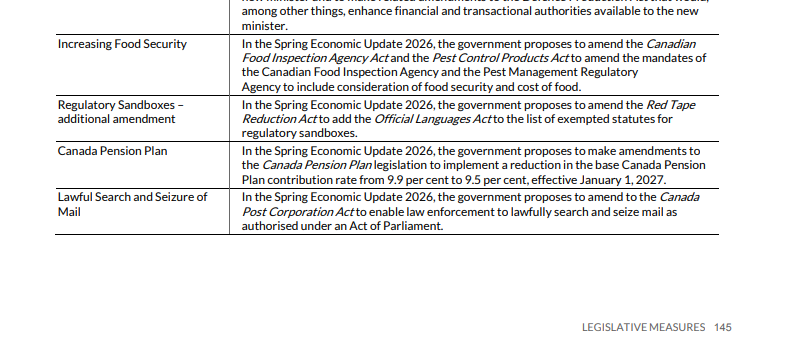
In the official update, the government proposes amending the Canada Post Corporation Act to allow law enforcement to “search and seize mail.”
The provision appears in Annex 2, page 145 of the document itself (page 153 of the PDF), within the government’s report.
Freedoms Advocate, a national charity dedicated to defending faith, family, and fundamental freedoms for all Canadians, is warning that this proposal has received little public attention and is calling for transparency, scrutiny, and immediate public engagement.
For decades, mail has been treated differently under Canadian law for a reason. A letter is not just an object—it is personal communication.
Weakening the legal protections around it is not a minor technical adjustment, but a meaningful shift in how much access the state can have to the private life of citizens.
“For generations, Canadians have understood that their mail is private—period. For most Canadians, this isn’t even on their radar yet—and that’s exactly the problem,” said Randy Crosson, Executive Director of Freedoms Advocate.
“A fundamental shift in how private correspondence can be accessed by the state is being advanced without clear, open debate. Canadians deserve to know this is happening—and they deserve a say before it goes any further.”
The government language states that such searches would be conducted “as authorized under an Act of Parliament.”
However, this wording does not meaningfully limit the power. Rather, it establishes a framework that could be expanded through current or future legislation.
“This isn’t about one line in a document—it’s about the precedent it sets,” Crosson added. “Mail is a deeply personal communication, not just another object. Lowering the legal threshold around it changes that relationship. Once governments give themselves new powers like this, history shows they rarely give them back. These kinds of changes don’t usually happen all at once—they happen quietly, step by step, often where few people are looking.”
The inclusion of this measure within an economic update, rather than as stand-alone legislation, raises further concerns about transparency and accountability.
“If this change is so reasonable, why wasn’t it introduced openly and debated on its own?” Crosson said. “Embedding a measure like this in a budget document—where most Canadians would never think to look for changes to their privacy rights—undermines confidence in the process itself.”
What Canadians Can Do Now
Freedoms Advocate is urging Canadians to take immediate, concrete steps:
- Review the proposal directly in the government’s official update.
- Contact your Member of Parliament and demand a clear explanation of the proposed change and whether they support it.
- Insist that any amendment be introduced as stand-alone legislation, subject to full parliamentary debate and public scrutiny.
- Share this information widely, as many Canadians remain unaware the proposal exists.
- Engage media outlets to ensure this issue receives national attention.
“This is a moment for Canadians to pay attention and speak up,” Crosson concluded. “Privacy is not a technical detail buried in fine print—it is a cornerstone of a free society. Canadians deserve clear answers before the rules around their private correspondence are rewritten.”
Want to know more? Read the Editorial on this topic.