
State Power & Surveillance
This is the final installment of a three-part series covering twelve federal bills that have started to quietly reshape freedom in Canada. Part 3 covers the bills reshaping how the government can identify and track you, or order your phone cut off.
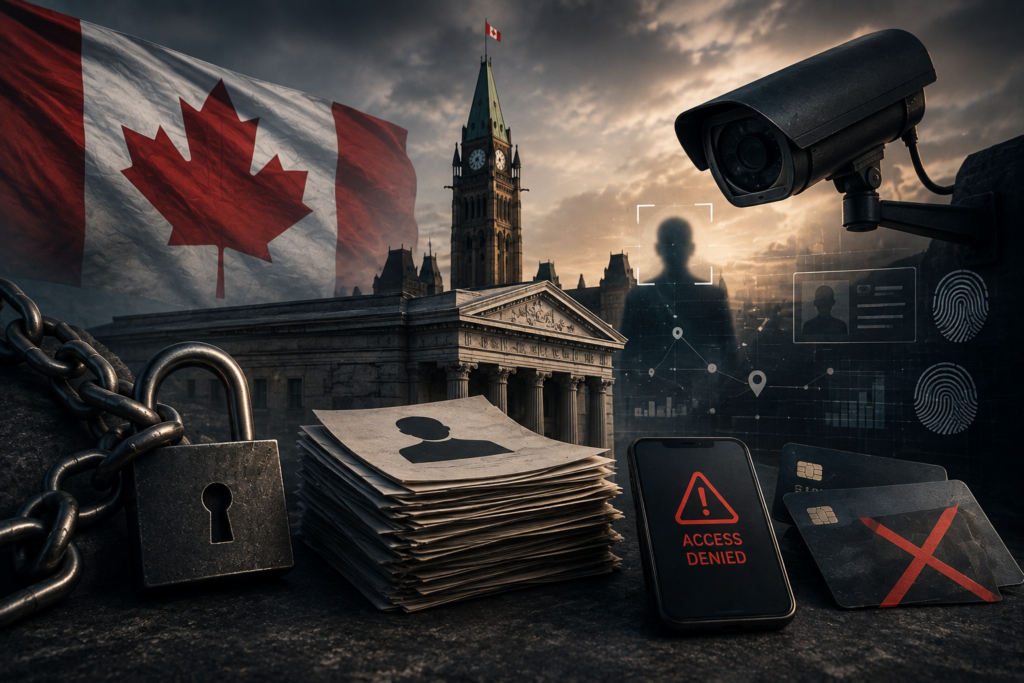
Bill C-2: Your Mail. Your Cash. Your Data.
Status: Introduced June 3, 2025. Its path has been unusually tangled. The immigration portions became Bill C-12 (now law) and the lawful-access portions became Bill C-22 (still pending). The bill’s exact current stage is genuinely unclear even in Parliament’s own records. Not yet law.
What it does: C-2, the Strong Borders Act, is an omnibus bill originally amending more than a dozen federal laws. Two distinct mail-related changes are involved. First, Canada Post’s own inspectors would gain authority to open letters, not just parcels, using the same “reasonable grounds to suspect” threshold that already applies to parcels. This doesn’t involve a warrant; it extends an existing administrative inspection power to a category of mail that was previously exempt. Second, and separately, the bill would replace a short, specific list of federal laws that currently govern when mail can be seized or detained with a broader rule: mail could be seized or detained whenever any Act of Parliament authorizes it, not just the handful of laws currently named.
It would also make it a criminal offence for businesses, professionals, and organizations that solicit charitable donations to accept a cash payment, donation, or deposit of $10,000 or more in a single transaction or a deliberately structured series of transactions.
The government’s case: The government frames C-2 as necessary to close enforcement gaps at the Canada-U.S. border and modernize CBSA’s tools against cross-border threats like fentanyl trafficking. Its own Charter Statement says police using Criminal Code powers would still need a judicial warrant to search and seize mail, and that the amendments don’t lower that specific requirement.
Why it matters: Canada’s federalPrivacy Commissioner disagrees that this is fully resolved: while police warrants remain required under the Criminal Code, the Commissioner’s office has warned that the bill’s actual wording doesn’t write an express warrant requirement into the mail-seizure provision itself, suggesting it could open the door to some other federal law authorizing warrantless mail search down the line.
Both the mail provisions and new financial-institution reporting powers as raising real section 8 Charter concerns. The cash rule doesn’t touch ordinary transactions between individuals—the legal obligation falls on the business, professional, or charity receiving the money, not the person giving it—but it would make it illegal for a church, charity, or business to accept $10,000 or more in cash in one transaction or a structured series, regardless of intent.
How this could affect you: The cash provision doesn’t restrict what you personally can give, but it does restrict what your church, employer, or any business or charity can legally accept from you. Separately, Canada Post’s expanded letter-opening power is a real, direct change to how personal mail can be inspected, using a lower “reasonable suspicion” standard rather than a warrant.
If your church could no longer legally accept a large cash gift, would you know why?
Bill C-8: A Minister Can Now Order Your Phone Cut Off
Status: Law. A renamed, updated version of the former Bill C-26, which died when Parliament was prorogued in early 2025.
What it does: C-8 amends the Telecommunications Act to make security an explicit policy objective, giving the Minister of Industry and Governor in Council authority to order a telecom provider to “do anything or refrain from doing anything” deemed necessary to secure the system. That language includes suspending service to a named person, without a warrant or prior judicial approval, and potentially under a gag order barring the provider from explaining why. It also creates the Critical Cyber Systems Protection Act, imposing mandatory cybersecurity duties on telecom, banking, energy, transportation, and nuclear operators.
The government’s case: The government presents C-8 as modernizing Canada’s cybersecurity posture for a changed threat landscape. Ministerial orders can be issued whenever there are “reasonable grounds to believe” a threat of interference, manipulation, disruption, or degradation exists. That’s a lower bar than a warrant requires. After critics warned the bill’s open-ended wording could be used to compel encryption backdoors, the government added language barring a minister from ordering the decoding of an encrypted private communication.
Why it matters: That fix addresses one specific action, decoding, while leaving the broader “do anything” order power intact. Critics say it doesn’t resolve the underlying concern. The enforcement teeth are substantial regardless: administrative penalties of up to $15 million per day for corporations, personal criminal liability for directors and officers, and no compensation for anyone who loses service as a result of an order. A five-year review was added after advocacy groups pushed back, but the disconnection and gag-order powers remain untouched.
How this could affect you: If your account or device is believed to pose a technical security threat, your provider can be ordered to cut off your phone or internet service. This can happen without a warrant or a hearing beforehand, and potentially without you ever being told why. A limited judicial review is available after the fact, though the government can present evidence in that review that you never get to see.
A law meant to stop hackers can also cut off your phone or internet. No judge, no warrant, no warning.
Bill C-22: Identify You Without a Warrant. Pushed Through Without Debate
Status: Passed third reading in the House June 18, 2026, after a programming motion cut off debate. Before the Senate; study begins September 21, 2026.
What it does: C-22, the Lawful Access Act, compels telecommunications and electronic service providers, including messaging services such as Signal, Gmail, and WhatsApp, to identify a person under suspicion of criminal activity, without a warrant, using a lowered “reasonable grounds to suspect” threshold that Michael Geist calls the lowest investigative standard in Canadian criminal law, down from the usual “reasonable grounds to believe.”
It also gives the Minister of Public Safety power to compel providers to build new “technical capabilities” for law enforcement access, mandates metadata retention (reduced by committee amendment from one year to six months), and streamlines international data requests. It includes a mandatory three-year parliamentary review.
The government’s case: The government maintains the bill does not weaken encryption: officials have stated it “does not require companies to weaken encryption” or allow indiscriminate access to devices. Facing what it called opposition delay tactics at committee, the government passed a programming motion setting a deadline for amendments before most MPs even knew it existed, then forced clause-by-clause review through an overnight sitting covering more than 100 proposed amendments, with only a fraction actually discussed.
The Conservative public safety critic called it the most aggressive programming motion he’d seen in five years in Parliament.
Why it matters: Technical and legal experts aren’t convinced the encryption safeguard holds up. The bill’s carve-out only bars ordering the “decryption” of communications, while separately empowering orders to build new access capabilities. Critics call that a contradiction in the bill’s own logic. Twenty-one civil liberties organizations and privacy groups issued a joint statement calling the process rammed through despite massive opposition, and Apple, Google, and Meta have warned the bill’s technical demands could weaken or break encryption.
Signal, DuckDuckGo, NordVPN, and Windscribe (a Canadian-headquartered VPN provider) have each raised the possibility of leaving Canada or relocating their headquarters if it becomes law as written. Signal has been the most direct, with an executive saying the company would rather pull out of the country entirely than compromise its encryption.
Some authorities want more. For example, Thunder Bay Police Chief Darcy Fleury told the committee that even 24 or 36 months of metadata retention “would be ideal,” well beyond what Parliament ultimately approved. Because the Senate won’t take this up until fall, there’s still a real window to reach senators before it becomes law.
How this could affect you: If police or CSIS have reasonable grounds to suspect you of something (a real but lower legal bar than the usual “reasonable grounds to believe”), they can compel a company to identify you as a subscriber to services like Signal, Gmail, or WhatsApp, without ever getting a warrant.
If the legal bar for identifying you were lowered, would you know how much lower it had gotten?
The Comprehensive Summary: What It All Adds Up To
Over this series, we looked at each government piece of legislation on its own terms: what it does, and the government’s justification for it.
Four patterns emerge once you place all twelve side by side:
1. Government action without a judge’s involvement. Bills C-2, C-8, and C-22 each let the government identify, track, or restrict someone without a judge’s approval. C-8’s telecom-security orders proceed on ministerial authority alone, C-2’s mail provisions rely on Canada Post’s own administrative inspectors rather than a warrant, and C-22 lowers the threshold that applies when a judge isn’t required at all.
2. New regulators shaping what platforms show and how they handle your data. The CRTC’s expanding role under C-11 sits alongside a single new regulator taking shape across two bills: C-34 creates the Digital Safety Commission, and C-36 expands and renames it the Digital Safety and Data Protection Commission, handing one new body, with no track record yet, authority over both online content incentives and private-sector privacy enforcement. None of these bodies directly dictates what any individual Canadian can say; their power works through platform obligations, funding requirements, and fines that shape what platforms choose to show or remove.
3. Financial oversight and data-sharing expanding quickly. C-2’s cash limits, C-4’s political-party carve-out, and C-15’s open-banking and stablecoin regime, plus the six-year regulatory exemption tucked inside that same bill, together represent a fast build-out of the infrastructure for sharing Canadians’ financial data, even though the open-banking piece itself only moves data when a consumer actively authorizes it, for now anyway.
4. Legal burdens and speech rules that widen once they pass. C-9’s sentencing increases and removed religious-expression defence, and C-25’s extension of election-speech rules to “all times” and undefined “potential candidates,” are two examples of the same pattern worth watching: provisions framed narrowly at introduction ending up broader by the time they become law.
What this looks like in real life: None of this requires wrongdoing. A small business owner’s internet service is suspended by ministerial order under C-8 because his connection is believed to pose a technical security threat, with no hearing before it happens and no compensation for the lost business.
A congregation can no longer legally accept a $10,000 cash donation in one gift under C-2. A parent’s information, gathered during a campaign door-knock, is logged and shared by a political party under C-4, with no way to see it, correct it, or have it deleted.
A sermon clip or a strongly worded post about a local school board decision risks being quietly taken down under C-34, not because it broke any law, but because a platform facing a fine in the millions may choose to delete anything borderline rather than risk guessing wrong. A citizen can be identified to police without a warrant under C-22’s lower-threshold lookup.
A small business owner’s financial data moves between institutions under a fast-growing data-sharing framework, only when he authorizes it, but the operating rules for that framework are still being written.
Each of these is a normal Canadian, doing nothing wrong, caught inside a system built for someone else.
Twelve bills, four directions, all pointing the same way: more state access without a judge’s sign-off, less independent oversight, and new enforcement bodies with no track record shaping what Canadians can say, see, and do.
Who do you think this could affect most, and how might it affect you?
The Summary: What it all adds up to
Over this series, we looked at each government piece of legislation on its own terms — what it does, and the government’s justification for it. Four patterns emerge once you place all twelve side by side:
1. Government action without a judge’s involvement. Bills C-2, C-8, and C-22 each let the government identify, track, or disconnect someone without a judge’s approval—C-8’s telecom-security orders and C-2’s mail provisions proceed on ministerial or CBSA authority alone, and C-22 lowers the threshold that applies when a judge isn’t required at all.
2. New regulators shaping what platforms show and how they handle your data. The CRTC’s expanding role under C-11 sits alongside a single new regulator taking shape across two bills: C-34 creates the Digital Safety Commission, and C-36 expands and renames it the Digital Safety and Data Protection Commission, handing one new body—with no track record yet—authority over both online content incentives and private-sector privacy enforcement. None of these bodies directly dictates what any individual Canadian can say—their power works through platform obligations, funding requirements, and fines that shape what platforms choose to show or remove.
3. Financial oversight and data-sharing expanding quickly. C-2’s cash limits, C-4’s political-party carve-out, and C-15’s open-banking and stablecoin regime—plus the six-year regulatory exemption tucked inside that same bill—together represent a fast build-out of the infrastructure for sharing Canadians’ financial data, even though the open-banking piece itself only moves data when a consumer actively authorizes it.
4. Legal burdens and speech rules that widen once they pass. C-9’s sentencing increases and removed religious-expression defence, and C-25’s extension of election-speech rules to “all times” and undefined “potential candidates,” are two examples of the same pattern worth watching: provisions framed narrowly at introduction ending up broader by the time they become law.
What this looks like in real life: None of this requires wrongdoing. A small business owner’s internet service is suspended by ministerial order under C-8 because his connection is believed to pose a technical security threat, with no hearing before it happens and no compensation for the lost business.
A congregation can no longer legally accept a $10,000 cash donation in one gift under C-2. A parent’s information, gathered during a campaign door-knock, is logged and shared by a political party under C-4, with no way to see it, correct it, or have it deleted.
A sermon clip or a strongly worded post about a local school board decision risks being quietly taken down under C-34—not because it broke any law, but because a platform facing a fine in the millions may choose to delete anything borderline rather than risk guessing wrong. A citizen can be identified to police without a warrant under C-22’s lower-threshold lookup.
A small business owner’s financial data moves between institutions under a fast-growing data-sharing framework—only when he authorizes it, but the operating rules for that framework are still being written.
Each of these is a normal Canadian, doing nothing wrong, caught inside a system built for someone else.
Twelve bills, four directions, all pointing the same way: more state access without a judge’s sign-off, less independent oversight, and new enforcement bodies with no track record shaping what Canadians can say, see, and do. Who do you think this could affect most — and how might it affect you?
A Final Word: Closing the Series
Over this series, we’ve walked through twelve bills, grouped by theme, and then stepped back to look at what they add up to together. We told you what the bills said, the government’s justifications for the legislation, and the Parliamentary record of their progress.
Most Canadians have never heard of most of these new pieces of legislation. That’s exactly why this series existed: to put the plain facts in front of people who care about faith, family, and freedom, in pieces small enough to actually read and share.
If this series mattered to you, the most useful thing you can do now is simple: forward it on. Send it to a friend, a family member, or someone in your network.
Support Freedom. Strengthen Canada.
Freedom doesn’t protect itself. Your donation helps Freedoms Advocate research legislation, fund legal challenges, publish independent analysis, educate Canadians, and defend the fundamental freedoms of speech, conscience, religion, and privacy.